Let's explain what we mean by storytelling collaboration. This is a more involved, less “objective” kind of journalism that embeds students into organizations to work on communication projects from within these change agencies. In this new approach, journalists operate from within the community, building trust from the ground up, prioritizing lived experiences as evidence and focusing on programs and movements that work to solve our big community problems.
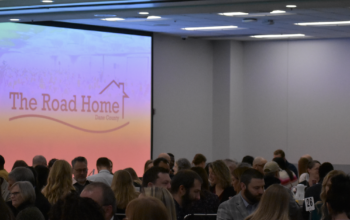
An example of what this new journalism might look like are solutions-forward events. In April 2025, we cohosted two community-wide events with our major partner on this topic, the UW Odyssey Project. (Special shoutout to Odyssey’s Success Coach Brian Benford, who educated my students on the issue, facilitated the work and cohosted the events with us!!). The first event, Let’s Explore the Family Scholar House for Madison, on April 3 brought together about 30 people, either Odyssey students in need of more stable housing or policymakers and housing organization representatives eager to find more solutions. The Family Scholar House is a model program in Kentucky and a few other places that provides heavily subsidized housing to nontraditional adults seeking secondary degrees. Part of our work included sending two of our reporters to Kentucky with Benford and other Odyssey folks to film a documentary there on the program.
On April 21, 2025, we had about 20 people gather for Know Your Rights, a free clinic with two UW–Madison Law School lawyers to educate us on what property owners can and cannot do and what rights renters have for getting their spaces fixed or in the event of wrongful eviction. You can find all of this content on our main Collaborative Storytelling page.
We not only asked for permission from our partners to publish some of our content such as profiles of people who had gone through their program, but also allowed these partners to review versions of the stories before publication for accuracy. However, we retained an independent editorial process at Madison Commons that included reporters performing fact checking and having a professional editor review the pieces for accuracy, quality and bias. We thank Madison Commons Editor (and SJMC faculty member) Stacy Forster and Managing Editor Louisa Kamps for participating in this important work and helping guide our student reporters.
Now about the money: All the students involved with this project received either one academic credit or a stipend for their work in the form of scholarships. We were able to pay some of the partners (who were not UW–Madison employees) for the labor of educating us on the issues. We paid for the two events as well. This money came from the Madison Commons budget, built from a hodgepodge of funds we scramble for each year. Only about a third of the budget is paid for by the School, and we fundraise and write grant applications to cover the rest. You can find out more specifics about our funding here. The project we implemented in Spring 2026 was supported by the Morgridge Center for Public Service as part of a course development pilot project.
These collaborative projects are not perfect by any means; we have a lot of hiccups and tricky navigating of journalistic conventions. At what point do we develop conflicts of interests? At what point do we cross “the line” and become activists? But we tried something new, something we hope can point us toward a means to stay relevant and rebuild trust to tell our communities’ stories. It is essential for us to be transparent about all of our relationships within each piece of content.
We invite you to learn about how Madison people and organizations are working tirelessly to resolve societal problems like housing insecurity and mental health. Please let us know what you think, or, if you have a story to tell related to solutions to big problems, please contact our publisher at robinson4@wisc.edu.