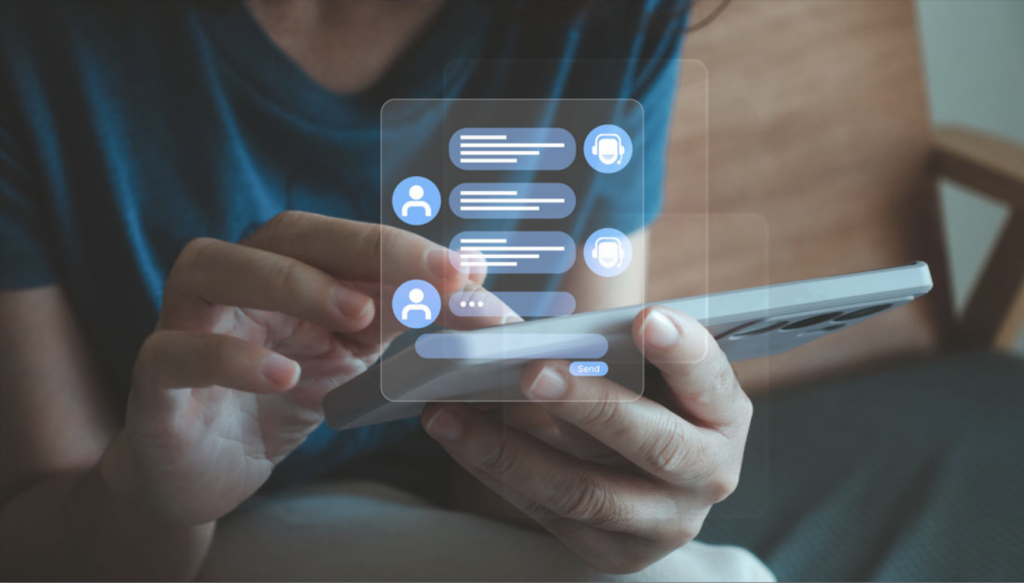

Madison Metropolitan School District teachers, administrators and even students report that legally required cellphone bans in the city’s public schools have had an overall positive effect on students’ learning.
With cellphones in nearly every high schooler’s pocket and generative artificial intelligence exploding in popularity, students’ attention is pulled in more directions than ever before. In October 2025, Gov. Tony Evers signed a bill requiring Wisconsin public school boards to impose some type of policy prohibiting the use of “wireless communication devices” during instructional time. Parents in Madison concerned about their children’s progress may be pleased to learn that, at least in the classroom, teachers are observing improved focus.
This is the first school year under the law, which gave districts until July 1 to adopt policies. While the law itself only requires schools to ban cellphone use during instructional time, in June, the Madison school board revised its policy to include students’ time passing between classes as instructional time. Students in kindergarten through eight grade are not allowed personal device use at any point throughout the school day, while high schoolers are allowed devices during lunchtime.
While some teachers and students note that not all MMSD high schools strictly enforce this policy during passing times between classes, one observation is universal: cracking down on cellphone use in class has had a largely positive effect.
Lawsen Swick is a special education teacher at Vel Phillips Memorial High School. He’s been teaching in the district for almost a decade and has worked at Memorial for the past three years. He said that during the COVID-19 pandemic, students leaned heavily on technology to get through remote learning. When education resumed in person, that reliance on technology continued.
“We normalized so much tech in the room,” he said.
When Swick started at Memorial, the school left the issue of technology use up to individual teachers.
“There was a lot of autonomy for teachers to have their own system,” he said. “And I think initially that was very confusing for students.”
With schools newly required to have personal device policies in place, Swick said he has seen less confusion. At Memorial, students are now always expected to have their devices “off and away.” A teacher who catches a student on their device when they shouldn’t be contacts the school’s so-called mobile response team to confiscate the device until the end of the day. Repeated violations of device rules can garner further intervention from the district.
“Across the building, the expectation is the same, and that’s been really, really positive,” he said.
Memorial’s instructional priorities include having students talk with one another about what they’re learning and reading from printed texts rather than screens. That level of engagement with learning, according to Swick, “hasn’t been higher” during his time at the school.
Most students stay off their devices without argument, he said. “They’re not too sneaky,” he said, and added that he gives the current generation of “kids some credit; they really are doing all right.” He and other teachers he works with “really pride [ourselves] on having really strong rapport and relationships with students, and I think that respect is just both ways,” he said.
“We have situations pretty frequently where a student is just honest, like, ‘Hey, I'm expecting a call about when I have to pick up like my sibling from school,’” Swick said. To his mind “that's totally fine” if they need to step into the hall to take the call, he said, “so there is a real give and take.”
A teacher at an MMSD high school, who asked to remain anonymous, was “shocked” during their first year in their current position “by [how] many students had smart phones and would take them out during class time.” Before the ban, the teacher said that each instructor dealt with tech differently and students had no consistency, which was “a recipe for a lot of phone usage during class.” They also attributed the difficulty in enforcing no-phone rules to the school’s staffing shortage and an overall lack of support for instructors who endeavored to prohibit or limit their students’ use of nonschool devices during class time.
This year, things have changed. “I used to have to prompt students to put phones away roughly five to eight times per class period. After nine weeks of school, I have had to get phones or headphones confiscated six or seven times total,” the teacher said. They consider it too early to say whether students’ learning has improved, but they have noticed students are undoubtedly more engaged in class and with each other. The teacher said they rarely hear any complaints about the new cellphone policy.
Still, the teacher was concerned about students finding ways around the rules. They said they’ve already noticed students beginning to attempt surreptitiously using personal devices during class and they expect more will follow.
Will, a junior at Madison East High School, said that most students have gotten used to the new rules. As at all MMSD high schools, students at East can only use their phones during the midday lunch break. According to Will, it’s not hard to get away with a quick phone check while passing between classes, but overall, people “are on their phones way less with these new restrictions.”
However, Will wondered whether the restrictions might be too stringent. “I personally think that for education purposes and getting people to be in class and not be on their phones, it’s useful. But yeah, there’s other times that I think that it's a little extreme.”
Madison’s action against phones is one front in a larger war. In districts nationwide, parents are turning against school-provided laptops and tablets in various capacities. According to reporting by CNN, by the 2021-22 school year, about 96% of public schools across the country had provided students with take-home devices, but across the country, coalitions of parents are forming to keep devices out of schools.
Last year, Parent Check on Tech, a Madison parent group lobbying the school board for an “away-all-day” policy in all schools, surveyed high school teachers in the area to find out their thoughts on the issue. Most, according to the group’s co-founder, Amy Martino, wanted a stricter device policy that took the burden of enforcement off of them. Now, after the implementation of the new ban, teachers in contact with Parent Check on Tech say they are happy, according to Martino.
“We are encouraged by reports of improvements in focus and engagement; however, we are also hearing that not all high schools are enforcing the policy during passing periods. We hope the district will monitor phone policy enforcement and successes and continue to explore phone storage and support solutions that ensure all students benefit from school environments that foster human connection and academic focus,” Martino wrote in an email.
Jacqui Shore, co-founder of Parent Check on Tech, also wrote in an email that teachers she’s in touch with are seeing better engagement and participation from students across the board. According to one West High School teacher she quoted, “I no longer feel like I’m one teacher on my own trying to compete with the metaverse for student attention.”
The district, for its part, is satisfied for now. “Based on the feedback we’ve received so far, the policy is working well, and we’re encouraged by how schools are implementing it,” Ian Folger, public information officer for MMSD, wrote in an email. “As with any new policy, we’ll continue to monitor how it’s working in practice and consider adjustments as appropriate.”
As a prerequisite to being allowed to speak with Swick, Folger asked to sit in on our interview. At one point, I asked Swick whether he was concerned at all about his students’ behavior outside the classroom: Was he concerned about AI use on homework?
Folger interjected, “Are we talking about the cellphone policy or the district’s technology plan?”
I said that I believed they were related –– if students are no longer as reliant on technology during the school day, what do we know about their reliance on technology for schoolwork in general?
“I feel like these are maybe two separate conversations,” Folger said.
We moved on. In August, just before the start of this semester, MMSD blocked or disabled AI tools on student Chromebooks, according to the Cap Times. And the district has a task force that is now developing a separate plan to introduce AI for student usage that it intends to release before next fall. But for now, the district seems to be happy with its progress on personal device use.