

By Alex Schmitz
Years ago, people with disabilities either had to live at home with a permanent caretaker, or in a group home where they lived in cramped space with a rigid care system that may or may not have worked with them, lacking any control in their own lives.
The U.S. Census has shown that people with disabilities are less likely to be employed and, therefore, were more likely to have less economic resources.
This reality leaves some people with disabilities feeling hopeless.
“I lived in a group home for eight years after my mother died from a brief illness. She took care of me for 47 years,” said Steven Salmon, an author and advocate of people with disabilities. Steven has cerebral palsy. “It was a major life adjustment having others care for me and living with roommates. I was never happy living in the group home even though I had an office and a bedroom.”
Steven is not alone. While there is little research on mental health outcomes of people with physical disabilities living in a group home, studies show – as in this 2024 article – that people with disabilities face depression and anxiety at a much higher rate than people without them. Studies, specifically of people with developmental or intellectual disabilities living in group homes, have shown heightened levels of depression and anxiety as well.
It’s important to note that you can’t make broad assumptions about all people with any kind of disability. Every person with a disability has individualized life experiences and needs, regardless of their disability.
The history of housing for people with disabilities is bleak as well, according to Kathryne Auerback, advocate and CEO of Movin’ Out, an organization that provides housing resources to people with disabilities. Madison Commons has been working a bit with Movin’ Out over the past year on content.
“Many decades ago, we were essentially warehousing people with disabilities, particularly people with intellectual or developmental disabilities, but even other people with disabilities. If you were not able to live at home with your family, your option was a large institutional setting,” Auerback said.
When the Americans with Disabilities Act was signed into law in 1988, these large institutions began to close after a series of class action lawsuits based on abuse and neglect, poor living conditions and inhumane treatment of tenants. This was a win for people with disabilities, but on the other hand, those who didn’t have families had nowhere to go.
In 1992, a group of parents in Dane County saw this dilemma and decided to act. They founded Movin’ Out three years later.
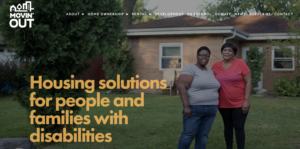
Movin’ Out, a nonprofit organization that helps people with disabilities in many ways, including providing housing support for people with disabilities and their families. Its housing counseling services help people find accessible housing they can afford, provides accessible renovation services, and it develops and operates affordable and accessible housing units built with green building standards.
Movin’ Out doesn’t only assist with rentals, it has a homeownership program that helps people prepare financially, such as supporting them from start to finish and providing down payment assistance.
In 2024, Movin’ Out provided counseling to 451 households, gave 38 households funding assistance to purchase their first homes, and supported more than 1,500 rental units – 337 of which are designed for people with disabilities.
“Having my own home gives me a sense of pride and an identity,” Steven said.
“Having a home for me is especially important to write. Over the past three years I have published a book,” he added. “Also, I have edited and revised at least four manuscripts numerous times working with my literary agent.”
Because of his condition, Steven uses a device where he taps his head to type letters in Morse code. He has published multiple books and posts regularly on Substack and thrives in his apartment that was built by Movin’ Out.
“The apartment allows me to write in peace. What I am doing is hard. My home is necessary for me to reach the mountaintop,” he added. “I love my home.”