By Xiaolei Xu
The webpage for the text story, with pictures: https://autismandarttherapy.wordpress.com/
A child squeezed paint from a tube for the first time, in an art studio in Suzhou, China. The paint got onto his fingers. Then, the child spread the paint across his face, clothes and the table, getting familiar with its cool, slick texture and watching it turn into different shapes along with the paths of the moving fingers. As the teacher gently repeated beside him, the child began to understand: this is “green.”
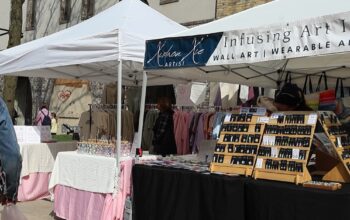
On the other side of the world, in an art exhibition in Madison, an adult artist conveyed emotions and recorded experiences through brushstrokes and colors, and successfully sold their first piece of work.
Both the child and the adult had autism.
But autism did not hinder them from expressing themselves or from communicating with the world.
Autism is a neurodevelopmental disorder marked by social challenges, diminished social interaction, impaired communication or language skills and repetitive behaviors. Across China and the U.S., organizations are turning to art not just as therapy, but as a pathway to inclusion for people with autism. Together, they offer insight into how art can bridge developmental and social barriers, while highlighting the need for more integrated, long-term systems of support.
Art therapy education healing autistic children
The children with autism twinkled alone in a distant galaxy and immersed themselves in their own small universe.
People in China often sometimes referred to them as “children from the stars.”
According to a 2021 report, the autism spectrum disorder (ASD) population in China exceeded 13 million, including over 3 million children below 14 years old. The Xing Er Plan is an organization located in Suzhou, China, providing assistance and service for children with autism. In Chinese, “Xing” means “stars.” Xing Er Plan offers drawing, music and dance lessons, as well as sport activities for children with autism to explore talents, build confidence and interact with the real world.
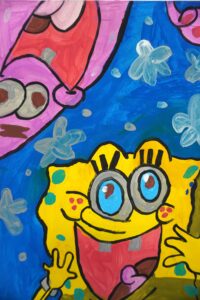
With the support from the government and the volunteers, the organization’s efforts have succeeded in helping children with autism exhibit their art works in public spaces, participate in performances on stage, and develop other life skills, such as going to lessons alone by public transportation.
Wei Shen is the art instructor in charge of Xing Er Plan. After her son was diagnosed with autism in 2017, she learned about Xing Er Plan in the parent support group chat. After participating in Xing Er Plan's work, Shen continuously studied and promoted art therapy education based on her professional art knowledge.
Shen said that the highlight of art therapy education is that it could naturally and seamlessly help children with autism improve their problems. When using paints, brushes and papers made of various textures, children did not feel they were being trained.
For example, when children first opened the pigment tube and squeezed out the paint onto paper, the teacher could intervene appropriately and tell them what color it was, which helped children learn at the cognitive level without any trace. This was different from the knowledge-based environment in special institutions, holding color cards to introduce colors to children. What’s more, when children painted on their bodies or tables, the shape and the size of the color area was not limited. Combined with the touch of the paint, it stimulated children’s vision and touch, helping those who are initially curious but sensitive to the pigment gradually desensitize.
Many parents might be more concerned about short-term effectiveness, such as whether their children could pronounce more words and actively communicate with other people. But art therapy focused on the cognitive development of children at a higher level. Under the active guidance of teachers and volunteers, children could discover a better version of themselves after creating works and realize that they can be seen and recognized by a larger world.
“Art therapy exercised children’s creative autonomy and taught them that humans and life are beautiful,” Shen said.
Shen supported every child to try experiencing art therapy. Children with autism have a weak perception of social interactions. For regularly traveling from home to systematic intervention institutions, children would become increasingly confused about what they were doing and their own existence.
“I noticed that our children are in a positive and uplifting state every time they come to the lessons. They would be passionate to try new skills as they gained confidence,” said Shen. “They also understood social etiquette unconsciously from college student volunteers’ behaviors, because they see volunteers as friends and role models.”
Similarly, music classes allowed children to move with the rhythm they like. The teaching method of repeatedly practicing a certain movement in dance conformed to children’s repetitive behavior traits. Performing on stage improved coordination and connection among children, and helped them desensitize and adapt to the lighting stimulation of the new space.
However, the development of art therapy education faced obstacles at the current stage. The art therapeutic system required a professional certification platform, so that proponents could illustrate its effectiveness beyond only using the past cases. What’s more, few teachers could develop and run the art courses. Shen’s capacity to provide services was nearing its limit. She felt overwhelmed to improve the curriculum, find like-minded educators and promote arts-based therapeutic programs at the same time.
“Actually our children in Suzhou already had relatively stronger social skills. Helping children without any prior experiences could be more challenging,” said Shen. “Training more teachers remained an urgent need.”
Nevertheless, Shen was grateful for the attention and support that enterprises, foundations and individuals provided, in terms of organizing and promoting activities. Shen hoped to expand the influence of art therapy education and invite the society to embrace this innovative method to educate and heal more autistic children.
The science behind art therapy
Dudu, a child with autism from Beijing, China, had an excellent prognosis after receiving intervention and treatment. Dudu’s parents discovered his sensitivity to music melodies when he was six years old, and therefore motivated him to play musical instruments, sing with the Peking Opera and recite traditional Chinese poems. Dudu gained extraordinary improvements through the understanding and immersion of arts. He is now a senior student studying music education at a university in China.
Dudu’s success caught the attention of research scholars to analyze the underlying science. Many clinical cases and studies showed that art therapy might be able to contribute in mitigating two main problem areas in autism: social communicative problems, and restricted and repetitive behavior patterns. Dudu’s story pointed out that the essence behind art therapy is to prioritize autistic people’s emotions and stimulate love and security in the brain.
According to Rong Zhang, an associate professor of neurobiology at Peking University Health Science Center, on the one hand, playing instruments and reciting literature could stimulate Dudu’s brain by sound and exercise his pronunciation, speaking and comprehension abilities. On the other hand, providing children with opportunities to explore their strengths and potential through art can drive healthy brain development, she explained. The positive feedback that children receive involves the brain’s reward mechanism, chronic stress and fear extinction, and even promotes social neurotransmitters, thereby developing children’s altruistic behavior, enhancing self-confidence, and connecting with their social surroundings, she added.
Among different forms of art, painting engages the visual system, music triggers the auditory system and handicrafts involve the sense of touch. “Each sensory modality corresponds to specific regions in the brain, and the level of activity in these regions reflects the development of different functions. Through assessment and research, practitioners can better determine which type of art therapy is most suitable for each child,” said Zhang.
Art in applied behavior analysis therapy
Compared to Xing Er Plan in China that centers art as a primary therapeutic approach, clinics like Mindcolor Autism in Madison integrate art into existing frameworks. In such settings, art supports skill development in structured interventions.
Mindcolor Autism provides applied behavior analysis (ABA) therapy services tailored for different families. Each child on the spectrum receives assessments, gets a supervisor and is assigned individualized treatments. With comprehensive programs, Mindcolor Autism has helped autistic children become more successful at home and school and get ready to be in the community, said Abby Tyson, Mindcolor’s center director.
The therapy is based on the principles of behavior analysis. Clinical specialists offering the therapy try to increase socially significant behaviors and redirect behaviors that might interfere with independent functioning.
At Mindcolor Autism, Colorful Connections is one of the specialized programs offered to children with autism aged six to nine. Beyond what its name suggests, Colorful Connections is a clinical model, designed by Dr. Amber Valentino, the Chief Clinical Officer at Mindcolor Autism,, that prepares autistic children to develop essential social, communication and independence skills.
Although not calling the activities in Colorful Connections “art therapy” explicitly, the team offers abundant art supplies, like paints and coloring pages, for children with autism who are well suited to and respond more actively to art-related activities. Art presented insights for skill-building within ABA therapy. Circling, doodling and picture-matching – the craft time not only mimics what the kids can do at school, but also aligns with assessments, such as evaluating the ability of listening to instructions. The key is to identify where the skills lie and what skills the families need.
Thus, Mindcolor Autism manages to tie the goals within ABA to the interests. When a kid really liked art, the team could do more of it.
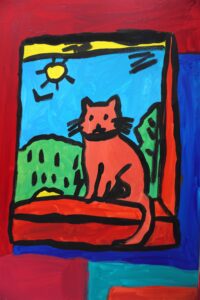
“What anecdotally is really exciting is to see” is the children being “proud of their work,” said Melissa Gerber, Mindcolor’s regional director. “When they get picked up by their mom or dad, they are sprinting and showing them the picture – ‘Look at the cat I made! Look at the ears!’ They are just so excited, wanting to hang it on the fridge.”
Nonetheless, families should take the limitations of ABA therapy into account, said Lily Wagner, director of the autism and developmental disabilities clinic at the Waisman Center at UW–Madison. She noted that ABA therapy has been controversial for using principles like reinforcement and punishment to reduce challenging behaviors. This could possibly prevent children with autism from learning in the most natural way. Critics argue that ABA therapy is repetitive in controlled settings and focuses on pushing kids to conform to neurotypical standards, which prioritize compliance over a child’s natural personality, emotions and self-expression. What’s more, the significant time commitment, approximately 30 hours a week, does not fit with many families’ schedules, she added.
But both Wagner and Gerber said that ABA therapy has evolved and adapted over the past decade. Wagner said that ABA “is really designed to teach independence in a systematic way,” and many naturalistic developmental behavioral interventions “incorporate ABA into teaching because it has been shown to be really effective.”
Aligned to Shen’s philosophy, the team at Mindcolor Autism wanted the children to improve naturally. “A lot of it is play-based or play-focused, because we want the kids to be able to have fun while they are learning and not really realize they are doing work,” said Tyson, the center director at Mindful Autism.. “We’ve evolved to really just focus on what the person and the family in front of us is telling us. There are ways that we can be flexible,” said Gerber. “If today is not the day to work on that skill, that’s ok.”
According to Shen, art therapy might not significantly improve autistic children’s language or interaction skills in a short period of time, but it has a more profound impact on them for guiding them to explore themselves and the world.
Choosing art as a main therapy or a supplementary tool depends on each family’s needs and circumstances.
“The goal should be developed in partnership with the parents. [Therapists] shouldn’t select the goals for you,” Wagner said.
The present and the future
Organizations like Xing Er Plan and Mindcolor Autism focus on autistic children’s early development and exploration but lack the resources, staff and expertise needed to guide children to employment channels as they become adults. In 2025, the Centers for Disease Control and Prevention estimated that over 5.4 million adults in the U.S. have ASD – more than 2% of the population. Autism identification varied widely across different regions and demographics, with Wisconsin having a notably higher prevalence at 1 in 26. And experts agree there is a major need for more funding and opportunities to carry out career-development initiatives.
“Now the biggest challenge is the transition from rehabilitation to employment, as there is actually a relatively long transitional period in between. So when we are working on projects, we will try to design them as continuous services rather than one-time support,” said Qin Jin, director of the Kunshan Disabled Persons’ Foundation, a charity organization in China that funds, promotes and participates in welfare activities for people with disabilities.
Still, all the successful stories gave many families hope and direction. Moreover, the future of implementing art to help the autism community is promising. As of now, China has established 17 independent special education schools for children with autism nationwide. With a professional and friendly environment, the government could further support the training of art therapy teachers and the systematic art therapy curriculum design.
Also, the National Institutes of Health has launched the Autism Data Science Initiative, a landmark research effort with more than $50 million in awards will support 13 pioneering projects that draw on genomic, epigenomic, metabolomic, proteomic, clinical, behavioral and autism services data, to examine the causes and increasing prevalence of autism spectrum disorder. As research goes in depth, researchers and therapists could also, in theory, combine the principles of art therapy with genetics, biology and neuroscience, driving art to achieve its greatest performance for the autism community.
“I think it has been one of our faults, starting with ‘What’s wrong? What’s the problem? How do we fix it?’” said Maria Stanley, medical director at Waisman Center Clinics.
“When we start with, ‘What’s great about this person? What are they good at? What do they love to do?’ it gives us opportunities for vocational outcomes that give people real life satisfaction and joy, and just continue to go back to that strength-based place.”