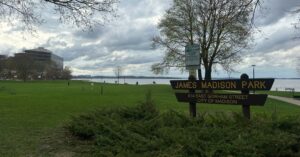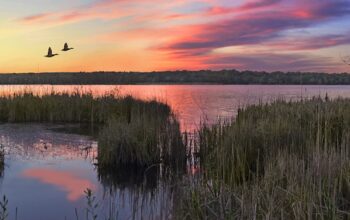
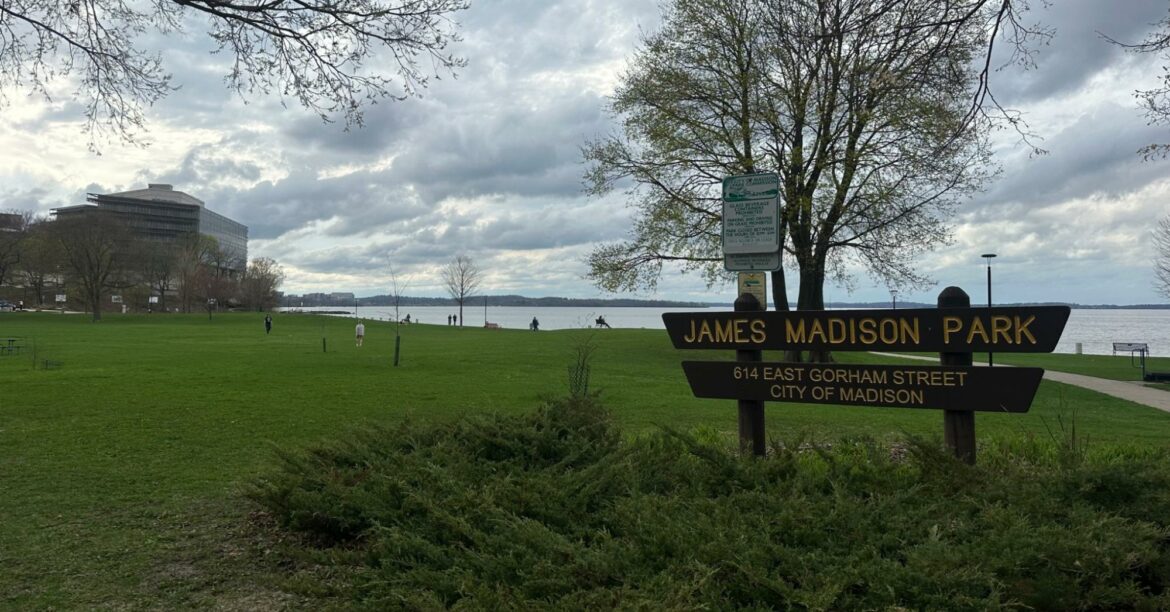
After a long and harsh winter, the first few days of spring are warmly welcomed by Midwesterners who have spent months indoors. Luckily for the people of Madison, one of the city’s 297 parks is likely within walking distance.
“When I moved to Madison in 2003 I was just shocked. You could throw a rock from anywhere and hit a park,” said Samuel Dennis Jr., a former professor of landscape architecture at UW–Madison.
Although parks have become a significant part of Madison’s culture and identity, that wasn’t always the case. As of 1892, the city had almost no public parks, except for a small space on the near east side known as Orton Park.
That changed when Edward Owen and John Olin created their vision for the Madison Park and Pleasure Drive Association. With the help of citizen contributions, the duo began constructing scenic roadways for carriage rides through Madison’s natural spaces. For almost 30 years, the association served as “Madison’s unofficial parks department,” but it eventually dissolved in 1938 after transferring its property to Madison’s park commission.
Nearly 90 years later, the Trust for Public Land, a national nonprofit working to ensure equal access to parks, estimates that now 98% of Madison residents live within a 10-minute walk from a park. Dane County Parks estimates the parks have more than 5 million visitors annually and more than 15,000 acres of parkland.
However, not all Madison residents have equal access to parks. Disparities in park space and accessible features still exist, particularly in low-income neighborhoods. Local advocates, including Madison Parks Foundation, are working to change this by funding accessible playgrounds and community programming. Ongoing advocacy offers hope that park accessibility in Madison will become reality for everyone living in the city.
In its report on Madison parks, the Trust for Public Land calculates that low-income neighborhoods are disproportionately impacted with 55% less park space per person than residents in average-income neighborhoods and 70% less than those in high-income neighborhoods.
Accessibility is another concern. Until Brittingham Park’s upgrade in 2017, none of Madison’s parks had accessible playgrounds. Brittingham Park’s accessible playground is now the first of five located throughout the city, due to efforts and advocacy from the Madison Parks Foundation.
Stephanie Franklin, president and executive director of the Madison Parks Foundation, emphasized that an accessible park “becomes a destination for families,” both for children with disabilities and older folks with physical limitations.
“There’s a large population of people who watch their grandkids, and if you have a mobility issue, that becomes a challenge for those folks,” Franklin said. “So this is a safe place for them that they can take their grandkids to. It was definitely a thing that was needed, and I’m super glad to be a part of that.”
In line with its motto “Parks for All, Forever,” the foundation focuses its fundraising to support projects that improve park accessibility by installing features like rubberized flooring, adaptive play structures and wide, level paths.
To improve socioeconomic access, the foundation funds a variety of programming for children and adults in under-resourced groups in Madison. One program at Warner Park, known as Kids Need Opportunities at Warner (K.N.O.W.),offers mentoring to kids and young adults, assistance finding employment and an open pantry for young people who have limited access to food.
“Whenever possible, everything is inclusive,” Franklin said. “We don’t want barriers like finance or mobility to prohibit people from using the parks.”
The biggest obstacle for the Madison Parks Foundation is a lack of funding for all of the improvements the group would like to make. A common misconception is the public’s belief that taxes fully support parks, leading many to feel no need to donate. In reality, only a small percentage of property taxes is allocated for parks.
In the early 20th century, when the Madison Park and Pleasure Drive Association was at its peak, as much as 75% of the population helped to improve parks in some capacity. Although financial donations from the public aren’t what they used to be, the Madison Parks Foundation still sees large groups of volunteers every year willing to assist with event planning and community outreach.
Beyond that, both Franklin and Dennis noted that the City of Madison has an active and dedicated parks department that works year-round to keep up with the large number of people the parks serve every year. The Land & Water Resources Department–Dane County Parks Division completes an updated Parks and Open Space Plan every five years. The department focuses on public outreach in the year leading up to each new plan to ensure they meet recreational needs while protecting existing natural and cultural resources.
“I love our parks department,” Dennis said. “When I grumble about how much property tax I pay in Madison, I think: We have awesome parks, we have great schools. They’re really good, and they’ve been really good for a long time.”
In his time researching environmental design, Dennis focused on the relationships between people and open spaces. He quickly realized that young people were the primary users of parks, but rarely had any say in how they were designed or the changes that needed to be made.
“I was trying to think of a way to translate their lived experiences into the language that urban planners and park departments use,” Dennis said.
Dennis eventually came up with the ideas for “participatory photo mapping” in which he provided kids with cameras that they would use to document their experiences in open spaces. The results were then entered into a geospatial data system to be presented to adult decision makers.
He noted that the most impactful changes came from kids directly presenting their experiences to the parks department, community or city council.
“Adding sidewalks was on the list of things the city wanted to do, but when the kids presented, it got bumped up in priority,” Dennis said.
According to Dennis, community presence in parks is the key to reducing dangerous activity within them and perpetuates the expectation of upkeep and care for urban green spaces. Continuing to make deliberate design choices and maintaining green spaces will be key to ensuring that every Madisonian has access to a great park space.
“We all saw how important the park system was when COVID occurred and we could only really meet outside,” Franklin said. “It’s part of what makes our community vibrant. It adds to property values, it adds a sense of community, it adds to your general health. There’s just so many benefits to our parks, and there’s not a lot of cities that have such a vast number of parks with so many different offerings.”