For the Kazakh diaspora in Madison, practicing the tradition of celebrating spring’s arrival has become more than just a holiday. Roughly 6,000 miles from their native Kazakhstan, on almost the complete opposite side of the globe, Madison’s small Kazakh community has found a way to reform the shape of home in an entirely different setting.
Culture and tradition are kept alive through community. In one’s home country, even in one’s hometown, there are rituals known to us via cultural osmosis. Our homes form a figurative container for our customs and memories to fill. In spring, the Kazakh community celebrates Nauryz, honoring the coming of spring and symbolizing life and renewal.
Originally a Persian holiday (“Nowruz”), Central Asian cultures adopted it as their own, officially recognizing Nauryz as a national holiday after the dissolution of the Soviet Union. It occurs on the spring equinox, when the long nights of the winter and the stretched out sunlight of the summer meet in the seasons’ transition.
On this year’s vernal equinox, the Kazakh diaspora is celebrating this ancient tradition in a room in the Frank Holt Center, a university-owned conference and event center near the shores of Lake Mendota. The night’s emcees, an American UW student and a Kazakh man living in Madison, call the holiday “ancient,” a tradition spanning “several thousand years.”
In Kazakhstan, this holiday is celebrated on the street — to honor the changing seasons, outdoor festivals are common. People erect yurts, serve food and perform music. They play games and gather in traditional Kazakh dress.
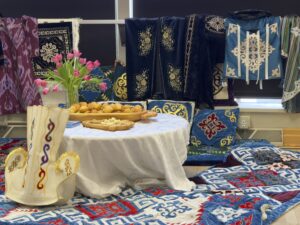
In Wisconsin, this festival has transitioned to accommodate the Kazakh diaspora’s new home. They’ve rented out a community meeting space and decorated it with traditional Kazakh symbols. Clothes, pictures and food are out on display. They don’t have anywhere to put up yurts, so they put miniature versions on tables.
And, since there are few Kazakhs in Madison — about 20 were present at the celebration — they’ve invited the rest of the community to come share in their traditions.
Most of the non-Kazakh crowd have roots in some other post-Soviet culture, mainly Russian. Other attendees aren’t Russian themselves but study Russian at UW–Madison. In light of this, much of the Nauryz festivities center around education about Kazakh culture. For such a small but tight-knit diaspora, remembering and celebrating culture necessitates bringing others into the fold.
The festival begins with a greeting and shashu — the spreading of candy and other small snacks to the audience – with someone walking through the congregation, throwing candy on the tables and floor. The gesture symbolizes plentitude and generosity.
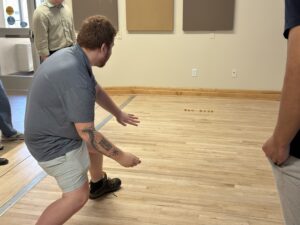
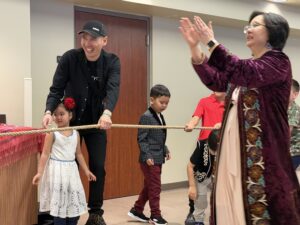
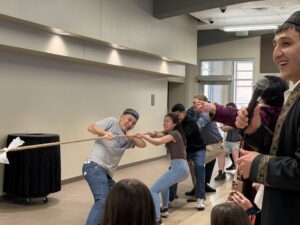
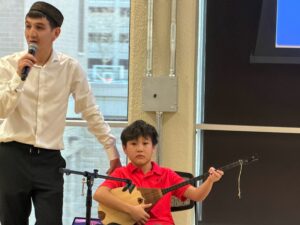
Those celebrating watch presentations on culture (for example, on the history of yurts and on shashbau, traditional Kazakh hair decorations). Everything this evening is available in three languages: Kazakh, Russian and English. Attendees play arqan tartys, a traditional Kazakh game that Americans know better as tug-of-war. A young man plays the dombyra, a pear-shaped, two-stringed instrument easily portable for a nomadic lifestyle. Later on, a few children will show off their developing dombyra skills as well.
Some try their hand at asyq, a game almost like bowling but with small sheep bones. Some of the non-Kazakh speakers learn to congratulate someone in Kazakh (“Quttyqtai’myn” is the most common word). Traditional clothing is on display and available to try on. Some opt to try on shashbau.
 Nick Libenzon, who lives in Madison, is there. Although he’s never been to Kazakhstan himself, his parents both immigrated to the United States from the Soviet Union – his father from Russia, and his mother from Kazakhstan.
“I really didn’t know anything about Kazakh culture, so first, I thought it was really cool that the Kazakhs were organizing cultural activities in diaspora,” he said. “Second, that they were taking the time to let me participate and teach me about it. That means something.”
All the while, long tables piled with home-cooked Kazakh food sit waiting. The event started a little after 4 p.m., and now, as the evening inches toward dinnertime, anticipation grows.
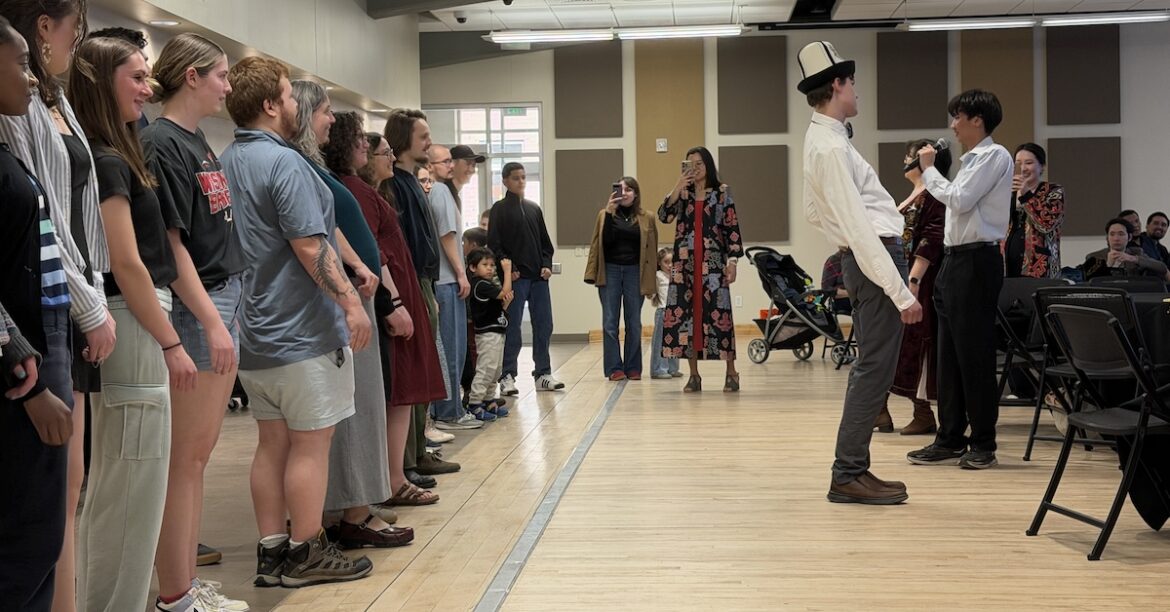
But before dinner, there’s a dance. The crowd lines up shoulder to shoulder, and learns to dance the Qara Zhorga. Before forced collectivization by the Soviets, Kazakhs were nomads. They rode and ate horses, traveling the steppe. The Qara Zhorga is meant to emulate a trotting horse.
We are a long way from the steppe, but the cultural memories of that land are recalled, even here.
Dinner is served at last. Everyone starts with a cup of nauryz kozhe, a soup made with meat, grain and milk-based ingredients signifying abundance in the new year. Then the crowd enjoys a full meal that’s authentically Kazakh. Those serving the food run out of paper plates, and those coming from the back of the line resort to filling cups with plov (known more commonly as pilaf), baursaki (a puffy fried bread), manty (spiced meat dumplings) and the like.
After dinner comes a blessing and another dance. By now, the room has taken on a different atmosphere. In the food, the music and the games, Nauryz has found a place in Wisconsin.
The willingness to gather a community, half a world away from home, has enabled this diaspora to transform a meeting room in downtown Madison. In Kazakhstan, the fog is clearing over Almaty and the steppe grows warmer. In Wisconsin, the lakes are thawing and the birds have returned north. But in both locales, at least for a while, people announce spring’s arrival in Kazakh.