
By Maddie Green

A teenager knows something isn’t right. They want to talk to a therapist but don’t want their parents to know everything they say. In Wisconsin, whether the teen can control that decision depends on a set of laws, hinging on the age of the minor, that most teens and many parents do not fully understand.
For children under 14, parents or guardians typically make treatment decisions. Once a minor reaches 14, they have more say in their own care, especially in outpatient services like therapy and participation in treatment.
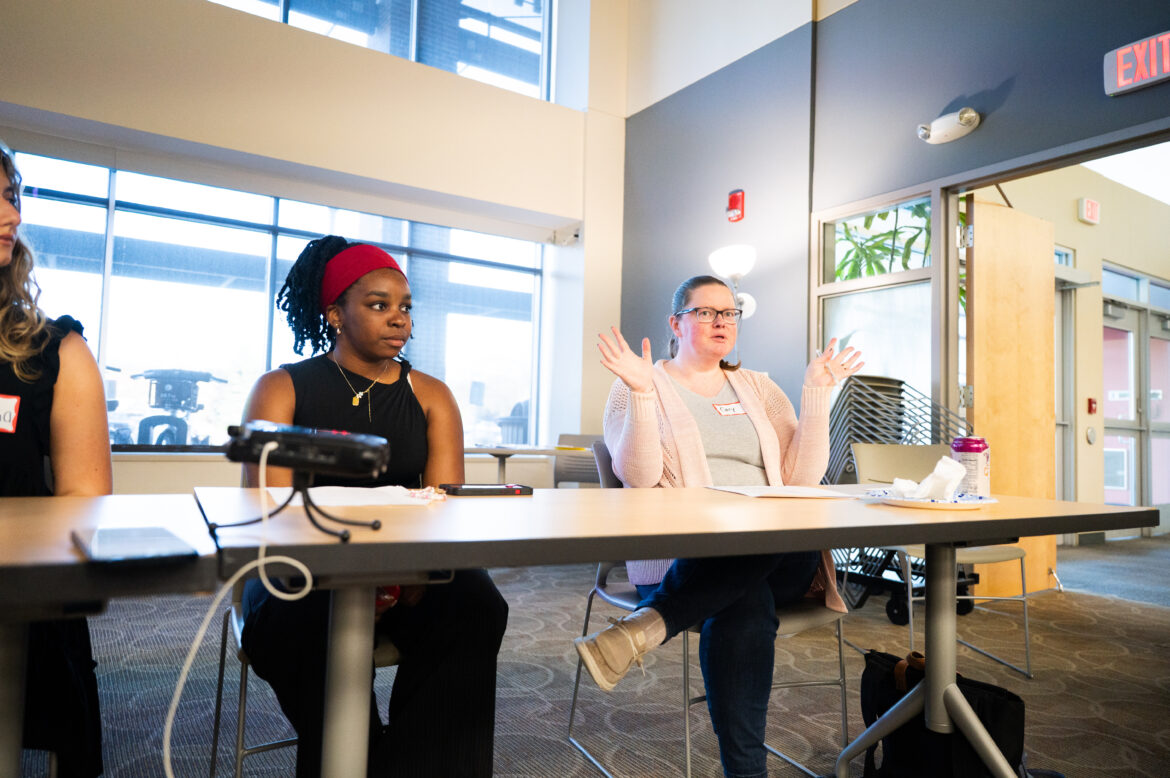
“One of the biggest surprises from families is that once a child turns 14, they have a lot more autonomy over their own treatment and privacy rights, parents have more limited access and ability to seek treatment for their kids,” said Cary Bloodworth, supervisor of the Family Legal Advocacy and Supports Clinic at UW–Madison Law School, speaking at a youth mental health panel on April 16.
The panel was part of a youth mental health resource fair for parents, teens and young adults, a collaborative project of the UW Odyssey Project and Madison Commons. Local Dane County organizations—including the Behavioral Health Resource Center, RISE, FLYY, Common Threads, Play and Learn, GSafe, Our Generation and others—attended to answer questions concerning youth mental health services and rights.
The panel and the organizations’ representatives emphasized that while legal rights exist on paper, access to care is shaped by real-world barriers like transportation, time, cost and lack of information. The experts also noted that low-income families in particular often are eligible for free or low-cost services but parents do not know where to start, or struggle to navigate systems while simultaneously managing their own personal mental health needs.
This article highlights a few important aspects of the many laws that govern youth mental health outpatient services in Wisconsin and resources to help you understand them. Many Dane County agencies that serve youth and their mental health needs can be found at the Behavioral Health Resource Center of Dane County; more resources and legal rights will be provided at the end of this article.
Age of consent

In Wisconsin, mental health care is heavily regulated before the age of 14. The Wisconsin Legislative Council, a service agency of the Wisconsin Legislature, outlines rights for outpatient services, including mental health care, in an online brief covering health care and confidentiality for minors. For providers to treat minors under the age of 14, a parent or guardian must give written consent. For a minor aged 14 or older, both the minor and the parent or guardian must provide consent for the minor to receive mental health treatment, according to the brief.
If the minor wants treatment that their parent or guardian does not agree to, the minor or someone on the minor’s behalf can petition a mental health review officer for a review. If the minor refuses treatment that the parent wants, the clinic/outpatient service provider must petition for review. Overall, clinics can provide outpatient mental health treatment, such as therapy (but not medication), for up to 30 days without consent. After that period, consent must be obtained or a review requested.
Petition process
Every juvenile court in Wisconsin has a mental health review officer appointed for that county. According to a 2021 flyer released by the Wisconsin Department of Health Services summarizing minors’ rights regarding outpatient mental health treatment, the review process begins only after a petition is filed, generally by a parent, guardian, or treatment provider, when consent for treatment is disputed. From there, the review officer decides whether to conduct the review personally or refer the matter directly to the court.
If the officer conducts the review, a hearing must occur within 21 days, with at least 96 hours’ notice. For treatment to be approved, even without consent, the officer must find that “the refusal of consent is unreasonable, you need treatment, the treatment is appropriate and least restrictive for you, and the treatment is in your best interest.” If there is still a disagreement on the decision obtained through the review, the minor and parent can pursue a judicial review.
If the officer believes the review is in the minor’s best interest, the officer review can be skipped, and the review will be done by the court. The hearing must occur within 21 days of the petition, and everyone must have at least a 96-hour notice of the hearing. The court uses the same standards as above to decide the best course of action for the minor. If the minor does not want the treatment, the court appoints an attorney at least seven days before the treatment. If the parent does not agree with the treatment, the court must also appoint one if one is not already obtained. The court’s ruling can be appealed to the Wisconsin Court of Appeals.
Records and privacy
Treatment information is generally confidential. If under 14, the minor can only view records with a parent or guardian, attorney, judge or staff member present; staff can limit access to parts of records but must explain why; medical information can always be viewed.
If 14 or older, a minor can consent to releasing their own mental health records; if 12 or older, a minor can consent to releasing substance use treatment records.
Treatment and personal rights
All minors are entitled to receive prompt and adequate treatment. If 14 or older, youth can refuse mental health treatment unless ordered by the court. At all ages, minors must be informed about treatment and care, and all minors are encouraged to participate in treatment planning. Additionally, the minor and family must be made aware of any costs of treatment that are being provided or will be provided.
All minors must be informed of their rights. No minor can be discriminated against based on race, national origin, sex, gender identity/expression, religion, disability or sexual orientation.
When more care is needed
Some minors require more support and care, often found through inpatient services. These services involve being admitted to a facility such as a hospital and living there temporarily. These services are often more restrictive than outpatient mental health treatment and can require 24/7 supervision, often only happening with strong legal justification.
According to the Wisconsin Department of Health, if a minor is 14 or older, they still have some consent/refusal rights, but courts can override refusal more directly and quickly, and a formal petition process to decide whether the minor stays in inpatient care. Courts or the review officer evaluate whether inpatient care is necessary, appropriate and the least restrictive option.
How to support reluctant youth
A question that came up at the Youth Mental Health Resources Fair in April was how to help young people and families who are hesitant or unsure about seeking treatment. Providers described how trust is often the most important factor in a young person’s decision to engage with services. Some explained that building that trust can take time and require a consistent, nonjudgmental presence before a young person is ready to participate in any form of treatment or care.
“One of the biggest gaps out there is the kids who are reluctant to accept support, but their parents need them to …accept support,” one provider said during the event. “The biggest thing we talk about is building a trusting relationship with them first. That is the foundation to any and all mental health work.”
Providers also emphasized that mental health support often involves working with entire families, not just the individual minors. Parents may also be struggling with their own mental health needs or come from backgrounds where mental health was never openly discussed.
One provider explained that improving outcomes often means “flipping the script,” making mental health care a more positive and collaborative experience for both the young individual and families. When parents engage in their own mental health work, it can make it easier for children to understand that seeking help is normal.
“Of all the things that can build a relationship,” one provider noted, the top of the list is having cohesive, consistent family engagement on the importance of mental health and taking steps when needed to treat mental health issues. For youth and families in Wisconsin, understanding mental health rights is not just about knowing the law but navigating a system where age, consent, privacy and family dynamics intersect. While minors do gain more rights starting at age 14, those rights exist within a larger system of parental involvement, professional judgement and, in some cases, court oversight.
Accessing mental health treatment includes not just recognizing where help is needed but navigating a complex system that must account for myriad factors and forces, including the fact that the support is often shaped long before entering treatment. Factors such as family stability, economic hardship, access to community resources, and more matter before a teen ever walks into a therapy office.
Laws exist to govern just about every dimension of youth mental health. Here are places to learn more about the laws and some resources to navigate them:
Legal System & Mental Health
- Chapter 51 (Involuntary commitment)
- Juvenile court involvement (Chapter 938)
Custody & medical decision-making
- Joint v. sole custody
- Role of Guardian ad Litem (GAL)
Role of schools:
- Mandated reporting laws:
- Resources to learn more about mandated reporting:
- Fact sheet from the Wisconsin Department of Children and Families: Mandated Child Abuse and Neglect Reporters
- Fact sheet from the Wisconsin Department of Public Instruction: Mandated Reporting and Supporting Overview as Mandated Reporters of Child Abuse and Neglect