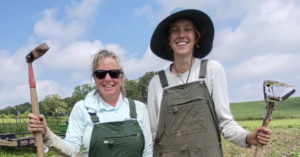
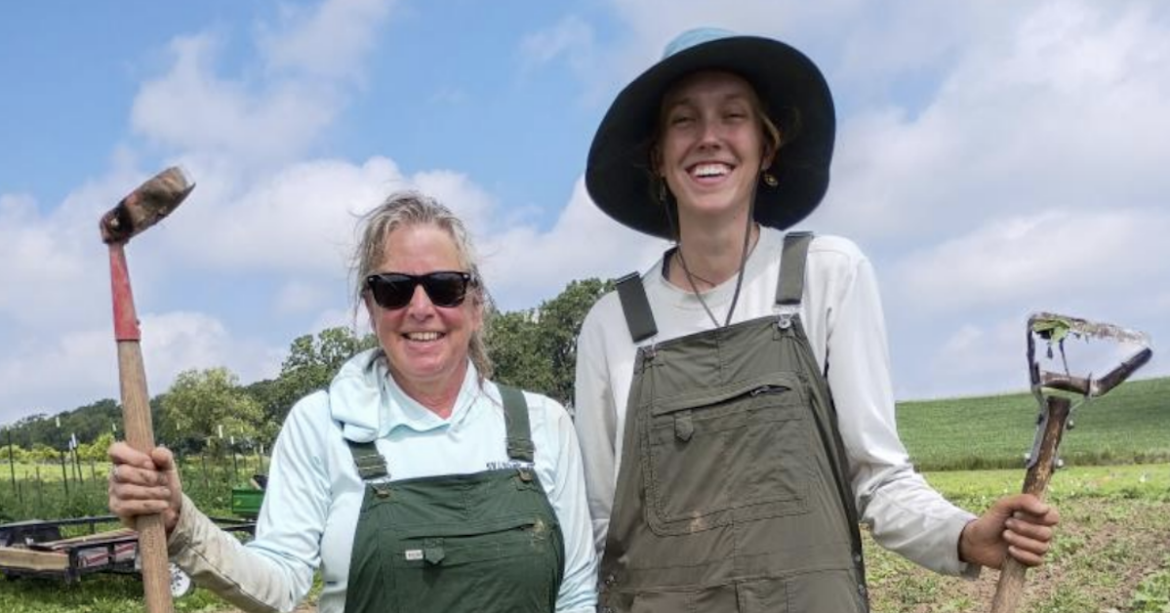
Kaila Topping started her farming journey in rural Virginia under a farming fellowship. In 2022, Topping moved to Madison to earn a master’s degree in agroecology and started working for the Gorman Farm in Fitchburg, Wisconsin. She’s now also the production manager for the Madison Area Food Pantry Gardens, the gardens’ second full-time employee. A nonprofit that was founded in the 1990s, the Gardens has donated an estimated 2 million pounds of food since its inception through the dedication and hard work of volunteers and the Madison community. Although Topping has only been in Madison for a few years, she has made many connections and had an impact within the community through her work.
What do you think is the biggest challenge our community faces?
I don’t know if I’ll call it the greatest, but having nutrition security for members of our community. Maybe you’ve heard of terms like food security, which is just having access to enough calories in the day to meet the demands of living. However, a lot of food that goes through food banks and food pantries is not always nutritionally dense, and so a big part of our mission and what drives us is providing nutrition security, so that people are actually nourishing their bodies and feeling dignified in the way that they eat.
But if we want to get bigger than that, I will say climate change is a huge issue that’s affecting everyone. I think it has greater impacts on people with less money and less power, and it’s affecting our agriculture and the way we can grow food. The weather is more severe, the pests and diseases are erratic, and that affects nutrition security, because if we can’t grow our food, if we have crop failure, worsening air quality, or more intense heat, it’s really hard for people to be outside and do this work. And that directly correlates to us actually getting food to people. It’s something we can’t ignore. Farmers, specifically, I think, are on the front lines with being outside and experiencing it every day. Things change every year, and they’re noticeable. There's a lot going on in this world, many things of great significance, and I just hope that this is one that stays on the forefront of people’s minds.
What do you wish people in our community understood better?
One thing in the emergency food system and growing food for underserved communities is that I’m never here to tell people how to eat or how to nourish their bodies. I do think there's a lot of power in understanding where your food is from and how it's grown. It’s pretty incredible to have so many volunteers come through. Some people are really avid gardeners and know a lot about growing food, and then other people are, like, “I didn’t even know what that looked like unless it's in plastic at the grocery store.” Learning to value food and what it takes to grow it and get it to you is a whole system that a lot of people are disconnected from, which I think is just a product of our community and our society. People don’t have access to land, they don’t have the opportunity to grow their own food, and it's a privilege to have the space, time, and resources to do that. Having a better understanding of where food comes from is pretty powerful and could potentially influence the way people consume or what they choose to spend their money on.
I value my food so much more when I have had some part in growing it, and it feels like a way of taking care of the community by sharing it. Food is very powerful, and I think it brings people together. I call it my love language. I think having more understanding of your local food system is a pretty powerful thing.
What is one change that would make life better for people in our community?
Just having regular and consistent access to food. Food insecurity affects people in many ways, socially and developmentally. And it often has lots of correlations to health issues. It affects all aspects of a person’s life. It's not just, “I'm hungry.” It affects your ability to show up at school and learn, your ability to do your job or whether you’re more predisposed to having heart disease or diabetes.
Eradicating hunger is such a lofty goal. I think in this world, we have enough food, but it's the waste and inequitable distribution that really screws people over. Also, income inequality — not paying people livable wages to be able to feed themselves and just live a reasonable life. I don’t think we have to teach people how to buy healthy food; I think we need to give people the actual resources to do it for themselves.
What in our community gives you hope?
I’m constantly humbled and amazed by the number of people that regularly show up in all weather, all conditions, multiple days of the week, to volunteer at the farm. It’s so incredible. There are young people coming out and volunteering. And I’m just, like, “You are prioritizing helping your community and putting other people before you and yourself and your needs.” And the number of hours that people will selflessly just give—the expertise, the energy, and just sharing a smile and showing up with positive energy gives me a lot of hope for the future.
We're right by the Pope Farm Elementary School, and one little girl saved up her allowance to donate to the farm at the end of the season. It amazes me, the generosity of people. One of our most consistent delivery drivers was a 95-year-old man. Just the way that people find ways to help and give their gifts is reassuring to me, and has given me a lot more faith in our community. I think it's easy to get cynical about things in the world, for many reasons, but knowing that there is goodwill in a lot of people’s hearts makes me feel hopeful.
This interview has been edited for brevity and clarity.