Imagine sleeping peacefully in silence. A fire alarm goes off in the early morning, while you’re still asleep. But the thing is, you are deaf. Even when your roommates begin banging on your door, trying to wake you, the sound doesn’t come through. You wake up a couple of hours later to find so many messages and missed calls about the alarms that went off while you were asleep.
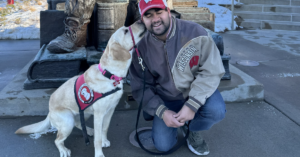
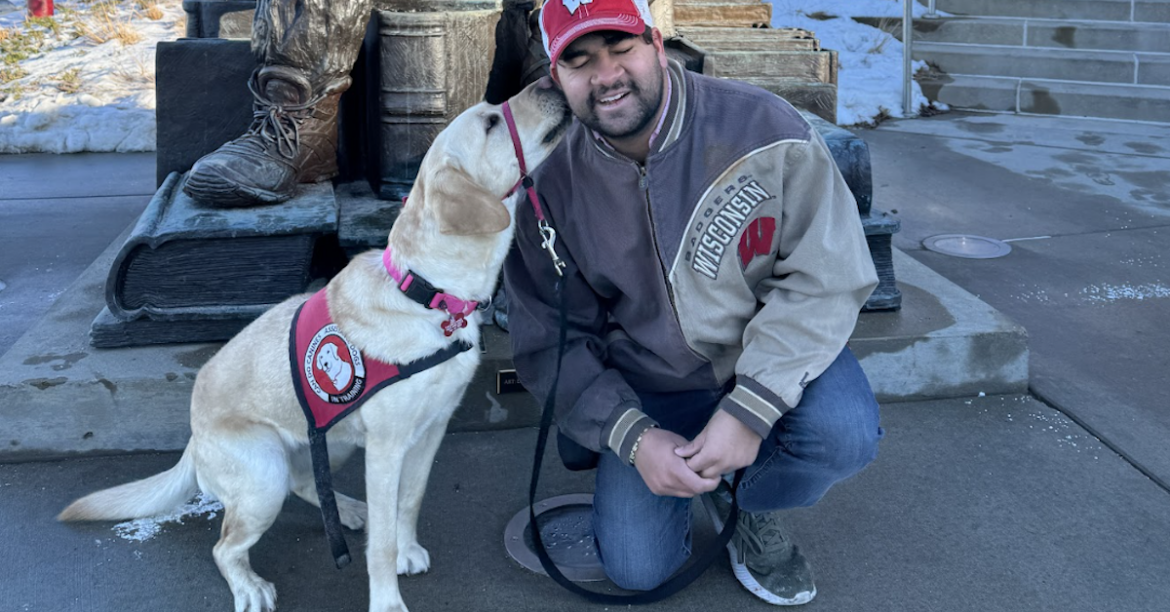
That happened to me while I was living in a dorm at UW–Whitewater back in 2023. After I woke up and learned what had happened, and even though it turned out to be a false alarm, I felt anxious and scared going to sleep. Which is why I now have Suki, a three-year-old yellow Labrador retriever who has become my hearing service dog. I live alone now, so it’s a relief to have her with me in case I’m ever in another situation where I need her to wake me.

When people think of service animals, they normally think of dogs that help to guide people who are blind or that provide emotional support for people suffering from mental health conditions, such as PTSD. But service dogs do much more than that, assisting people with hearing loss, diabetes management, allergy detection, emotional regulation (helpful for people with autism), mobility issues and seizure disorders. Early last year, when I knew I would be moving from Whitewater, where I attended college, to Madison, where I am now in grad school, I decided to apply for a service dog with Can Do Canines, a nonprofit based in New Hope, Minnesota. I filled out forms online, then went on a waitlist but was optimistic because Can Do has assigned over 700 assistance dogs since its founding in 1987, free of charge. At any given time, Can Do typically has about 40 dogs on site. Those dogs don’t always end up getting matched with clients, but the organization tries to place 50 dogs with clients annually, said Laura Hoffman, Can Do Canines’ client service coordinator.
Typically good service dogs are motivated by toys or treats. “We want our dogs to be able to focus on their handler in the midst of multiple distractions,” said Hoffman.
In addition to training dogs to assist people with disabilities, Can Do also trains dogs to work in facilities — hospitals, police departments and rehabilitation centers. On my application, I had to write down in detail why I needed a service dog. I also had to provide a doctor’s note and two professional references from people who could attest to why I needed a service dog.
In May, I was invited to a video interview with reps from Can Do to discuss my disability and explain why I thought I would benefit from having a service dog. I found out in June that I was at the top of the waiting list. Then, last December, I received an email that described Suki and included a picture of her. After months of waiting, I threw my hands up in joy over this news. The email also included a list of commands I was to memorize.
Luckily for me and the others who are assigned service dogs, Can Do Canines works with a range of volunteers, including puppy raisers, dog sitters, breeder hosts and prison volunteers who help train the animals. The raiser volunteers host service dogs throughout most of their training and provide them with exposure to people and stimuli in a variety of settings, schools, stores and sports games. This teaches the dogs to learn how to stay calm, focused and follow commands without getting distracted.
They work on promoting good house manners through potty training and preventing negative behaviors like counter surfing to snarf food. They also establish all the foundational cues, from “sit” to “down,” then go on to teach dogs specific skills like retrieving items, opening doors or alerting people to sounds, as needed.
“One important thing to remember is that, while these dogs are highly trained and skilled, they are still dogs. They can have off days or encounter challenges, just like people do,” said Mckenzie Ryan, a volunteer with Can Do Canines who helps raise and train dogs.
A couple weeks after I learned about Suki, I met her in person for the first time. She immediately rubbed her head against my legs to say hi, which was one of the sweetest introductions I’ve ever received. Her hyped-up energy made me smile.
I had three days of training with Suki in Minnesota. Our lessons took two hours each day and focused on learning how to use commands and help her continue practicing her skills. I learned to use command phrases like “stand” or “park” when I was sitting on a chair and wanted her to go under my seat. I also learned that if I said “pretty” to Suki, she would stand up in a prairie dog stance, which was also pretty cool.
We also had to practice having Suki walk by my right side because I am dominant on the right side and it’s easier for me to hand her treats with my right hand. If she walks too far ahead, I say the word “side” and she walks back to my right side. I learned, too, to immediately reward Suki with a bit of kibble for doing her job.
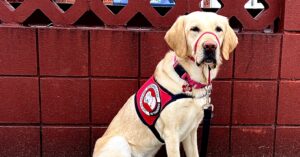
I learned the skills training that if Suki gives me a hard nudge, it means there’s a fire alarm going off, someone knocking at the door, my phone is ringing or someone is calling my name from a distance. A highlight of the training was going to a Target with Suki while the service handler filmed us doing the skills and commands to confirm that she and I were connecting well together. Finally, after the training was complete, I got to take Suki home with me, starting our adventures together.
After we returned to Madison, the first two weeks were difficult because I wasn’t used to having a dog with me every second of the day. I wasn’t used to the responsibilities of taking her for long walks, feeding her, bathing her, buying her stuffed animals and brushing her teeth and her hair every day. However, I got used to it pretty fast.
During the next couple of months, I worked with a local service animal handler to continue training with Suki once a week. This allowed us to focus on the skills that were some of the hardest to master, including getting her to nudge me when the phone rang or someone knocked on the door. But over time, she picked it up, and now she alerts me instantly.
Service dogs are important because they “provide their persons with disabilities independence, the freedom to do more” and a general peace of mind, said Ramona Elder, a Can Do Canines’ service dog trainer who has 15 years of experience. Over time, I’ve learned that Suki loves to cuddle, to jump up and down in the snow and to be showered with compliments. She also loves to eat just about anything. Also, her way of saying hello is to weave back and forth between people’s legs.
I have realized over time, too, that it is important for me to make Suki know she is doing a good job in order for her to want to continue using her skills. Complimenting Suk with phrases like “Good job, sweetie! You’re such a good girl!” seem to give her reassurance and make her happy.
Next month, Suki will be graduating as an official service animal. She will also be able to help me get people to open up, since she comes with me in my work as a journalist, always making people smile. There are more adventures to come, and we are both looking forward to them.