Jake Leismer was still in high school when he realized that somethings – or someones – were missing.
In places where important decisions were being made in his hometown of Sheboygan, Wisconsin, he found he was usually the only person in the room under 50. It wasn’t that his peers didn’t want a voice in the conversation, he said; they just didn’t know how.
“Young people want to be involved,” Leismer said. “But they don't know the pathways to be involved.”
So in his senior year, he decided to build one.
What began as a small, local effort soon became the Wisconsin Youth Voters, a nonprofit organization helping young people register to vote, provide information about candidates and encourage showing up at the polls. In its three years of existence, the student-led group has spread from Sheboygan to the Madison area and across the state of Wisconsin.
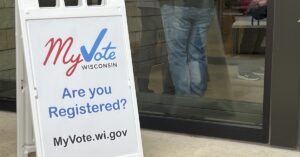
The group operates on three pillars: registration, information and engagement. The idea is that if they can simply teach college and high school students how the process works, they will be far more likely to actually vote when election season comes around.
Indeed, while youth voter turnout has increased in recent years, voters ages 18-29 continue to vote at a much lower rate than their older counterparts. The Civics Center, a national organization working to make voter registration more accessible for high school students, reported that only 10.5% of 18-year-olds in Dane County were even registered to vote in 2022. According to The Civics Center, just 30% of 18-year-olds nationwide are registered for midterm cycles, compared to 75% of voters ages 45 and up.
And this issue isn’t new. Connie Flanagan, a former professor in the School of Human Ecology at UW–Madison, notes that older generations have had more time to develop voting habits, giving them a leg up.
“No matter what era we're in, young people are less likely than older people to pick up the habit,” Flanagan said. “Once you start, you keep doing it.”
Picking Up The Slack
A participation gap of this magnitude doesn’t come from just one cause. Some young people, especially college students, move around a lot and don’t always live near campus long-term. Others, Flanagan says, lie in the shortcomings of schools and universities.
“We do expect our educational institutions to train people for jobs. So often those [priorities] are at odds with opportunities to share perspectives,” Flanagan said.
“I don't think civics is being as widely taught in schools as it used to be,” said Beth Fultz, voter service director for the Dane County League of Women Voters. “And so maybe a lot of students don't really understand the structure of government and understand how you can have an impact on that through voting.”
That lack of civic education can make it difficult for young people to identify good information, especially in an age when so much of it is available right at our fingertips. UW-Madison student and voter Spencer Axness said reliable facts are getting harder to come by.
“It’s tough when you can open social media and the first thing you see is fake headlines or something that is just blatantly false,” Axness said. “It makes you wonder what you can even trust anymore.”
This is where Wisconsin Youth Voters sees an opportunity to fill the gap. By holding registration drives and directing young people to primary-source sites that publish non-editorialized answers from candidates, the organization has the opportunity to both make up for what institutions fail at and face the rising challenge of mis- and disinformation.
“We just try and get ourselves out there because we know that we have reliable information and can connect people,” said Ireland McQuillan, partner relations director for Wisconsin Youth Voters. “So if we can connect with the community, we can give them direct access to sources that are accurate.”
One of the most direct methods for the organization to reach out to voters is through canvassing: knocking on people’s doors and having face-to-face interactions with people in the community. Leismer says this approach, along with talking to seniors at local high schools, allows them to meet young people where they are instead of relying on them to make the first move.
“High schools are the last place where we see everybody mandated to be in one spot at the same time,” Leismer said. “That’s our principal strategy, is working within the institutions that already govern student lives.”
A Glimpse of Progress
McQuillan says that while it can sometimes be difficult to truly track if their efforts are succeeding, a good indicator is comparing the number of students they’ve talked with to how many students actually turn out for an election.
And while it is still early, April’s state Supreme Court election is showing that its efforts are paying off: the group says 8,500 students in student-heavy wards around the UW–Madison campus voted, a dramatic increase from the last spring election. Estimates from Tufts College’s Center for Information and Research on Civic Learning and Engagement suggest that 47% of people ages 18-29 nationwide cast a ballot in the 2024 presidential election, slightly lower than the historic 2020 election (50%) but a considerable improvement from 2016 (39%). Although, it is important to note that Wisconsin was not included in that estimate as they, along with many other states, do not reliably record age/birthdate data in their voter files.
While it’s hard to attribute these results to any one effort, organizers see it as a sign that reaching out to young people personally is making a difference.
“When you talk to students in these younger populations, they often seem a lot more receptive than they would have been 10 years ago in 2016,” McQuillan said.
Working Together
Though numbers like these seem promising, the group recognizes there is still more work to be done; per the U.S. Census Bureau, while young Wisconsinites led the nation in voter turnout at 48.7%, they were still well below the state average of 61%.
To help close this gap, the group is collaborating with other established organizations in the area like the Dane County League of Women Voters to hit multiple points of outreach. In working together, Wisconsin Youth Voters teaches where and how to register, and the League of Women
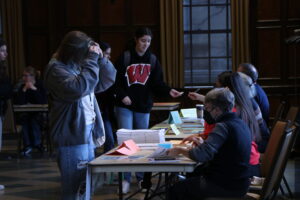
Voters can be right there waiting to actually help young people register. McQuillan says teaming up with groups like the league allows for name recognition and learning how an organization should be properly run.
“[Working with the League of Women Voters] gives us insight into how groups like that who've been around for a long time and who are very successful run their organizations,” McQuillan said. “It’s really a learning process for both groups.”
The league is testing a program where it helps Dane County’s eligible voters register at Department of Motor Vehicles locations. They suggest that people take care of their DMV business first, and then they’re there in case someone needs help registering or changing their address. Fultz says this is a consistent way to encounter young prospective voters who may be looking for a way to take care of everything at once.
“Everybody goes to the DMV, so it's a good place to see the whole cross-section of folks who live in the county,” Fultz said.
Taking Initiative
Still, these groups understand that larger obstacles remain. Outreach can take a lot of time, relying heavily on volunteers who are busy in their own right. Reaching students in rural areas presents additional logistical hurdles, from transportation to smaller school populations.
And while many young people are receptive, not all are convinced.
“What you see all the time on the news is power, and it's not most of us; it's an elite,” Flanagan said. “You may have a real sense that there's not much point, and it doesn't change because there's a lot of evidence that that's true.”
Flanagan noted that many of the benefits coming out of politics disproportionately help older generations, while the younger ones sometimes get left in the dust. A lot of that, she said, has to do with the way our economic system currently functions.
“Young people get jobs, but those jobs don't have the kinds of guarantees that jobs in my generation had,” Flanagan said. “There's much more of a gig economy. A whole lot of the jobs that young people get are contracts that are only a few years, so why would you buy in?
“I think apathy is a problem that's growing in young people,” Leismer said. “But I also think that they want opportunities to change this apathy into meaningful action. And they feel like the institutions that exist right now aren't offering a meaningful path to do so. And so it's kind of encouraging them to take ownership of their own futures.”
In Leismer and McQuillan’s eyes, young people owning their futures starts with taking initiative at the polls. And initiative at the polls starts with groups like Wisconsin Youth Voters showing them how to get there, one meaningful interaction at a time.
“It may seem scary, but people are going to be there and they're going to be helping you out,” McQuillan said. “And it's actually a really joyful experience; I always love going to vote.”
Leismer added that it can seem like a big choice at first, “but it’s really a simple process. Once you know the steps involved, it's your civic duty to get in that ballot box and make your voice heard.”