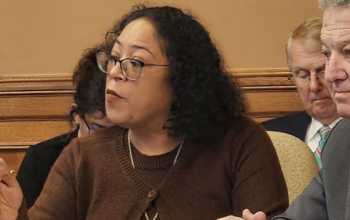
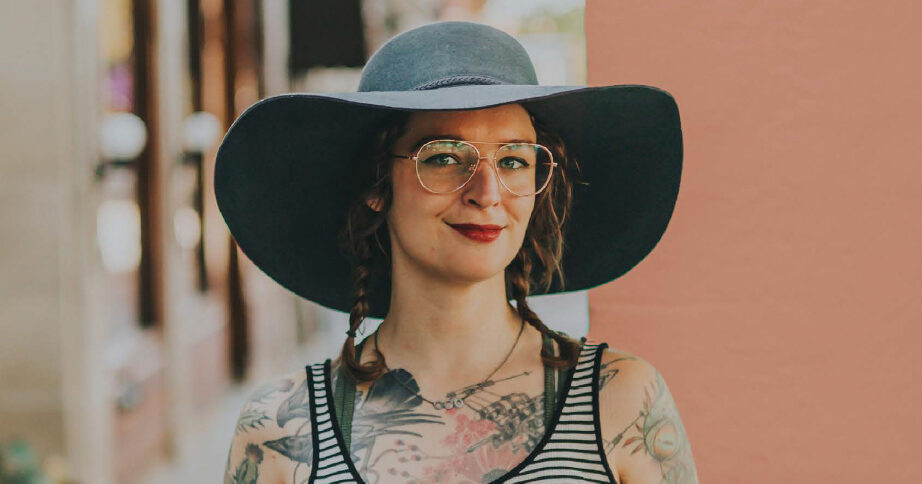
T.L. Luke is a professional muralist, illustrator and a queer artist based in Madison with invisible disabilities. She is known for creating comics that explore political issues in current events as well as shame-free insights into subjects like state taxes, cannabis reform and destigmatization. She also advocates for art equity, queer issues, disability rights, mental health and more. She grew up in a conservative town and, while attending UW–Whitewater, gained exposure to more points of view and ideas that she wasn’t exposed to growing up.
Luke is also a book illustrator, teaching artist, activist and public speaker. She has illustrated two books, “How to Be a Difficult Bitch” and “Rebel Girls Celebrate Pride.” She started her own multifaceted art and design business, T.L. Luke Art, in 2018. She is currently a member of the Madison Arts Commission and chair of the commission’s public arts subcommittee.
What do you think is the biggest challenge our community faces?
I use a term that I heard Jordan Klepper, The Daily Show correspondent, use when he was asked, “Do you change anybody’s mind when you’re at Trump rallies?” He said, “No, because I believe that we’re living through a crisis of certainty.” I was like, That’s it—I feel like Madison has a large population of educated people who know a lot of things, and others who just feel very certain about what they know. I think that is a crisis. I think that what is happening right now is that a lot of people are getting their news on social media; they are diving into just headlines. Every time I’ve talked to people these days, it’s like, “Did you see this post on Threads?” There’s this poor media diet where a lot of people don’t have literacy when it comes to learning new information or thinking critically about unverified information. Especially right now, when it’s this explosion of misinformation, which is being used as ammunition to distract. When we start grasping onto misinformation that we’re assuming is fact, then we might be attacking local communities that are not in the wrong, but we are. I think that our local community could use some training, like relearning how to be wrong, learning how to access information, who your trusted messengers really are and what experts to rely on. We need that second step of critical thinking.
What do you wish people in our community understood better?
I wish people in the community knew how to not be so performative, to go beyond talking about the issue or sharing a story about the issue. For example, I’m in the community and work with the Department of Human Services, which has the Youth Justice and Prevention program. They work with so many at-risk youths in the city. They have all these resources for reconnecting them with incarcerated parents and expulsion from remediation. One area that I have a lot of passion for is working with those students to make murals or get some literacy around digital media. There are so many programs in Madison that are reaching out to our most underserved communities but many people who like to volunteer don’t know these programs exist. How do we fill that gap and let people know they exist?
I also think we have this boom of too many nonprofits in Madison, because everyone has this helping ego: “Well, then I’ll do it, I’ll make this thing,” and then it’s, “Ah, this thing already exists over here,” and now you guys are battling for grant money when this could have all gone to one organization to do the proper work. I wish that Madison realized that there are a ton of active working programs that have been working for decades. I don’t think that Madison knows that they could be actively helping their local community and the people, like immigrants. If you care a lot about the ICE problem, talk to the immigration center here and see what immigrants here need help with. We have signs in our yard, but it just can’t end there. There are so many active things that we can do.
What is one change that would make life better for people in our community?
Every community is different, but what I have found is that when you turn and investigate the community you’re in, you see what is needed. The most effective way in the community is to actually be present. For example, Zohran Mamdani in New York—how refreshing it is to see somebody do their job? A big part of his campaign was free buses —very simple—but it’s because he’s in the community, and he knew what New York City needed. This is what they want, this is what we’ll give them and we will absolutely follow through. It’s about understanding your own specific community, and the only way to do that is to be involved in it. It happens organically. It’s as easy as showing up.
What in our community gives you hope?
We don’t need to convince people of certain things that are happening here. We are aware. I appreciate that Madison does seem to have their finger on the pulse for where we should be going forward. And I’m very hopeful that once the performance is done—because we have the vocabulary—hopefully, with people like me who want to bring information forward and get people thinking, “Oh, I need to volunteer here,” or “I need to help this project,” then we’ll get some action going.
Speaking as an artist in the community, I think that Madison understood the assignment last year, and I’m hopeful that they will continue to understand that you must support locals. I do the maker’s markets here and the farmer’s market—that’s how I make my main income, selling my products in the community—andhe community shows up, and that is amazing. That’s real. That’s not performative.
This interview is edited for brevity and clarity.