
By Amari Mbongwo
Correction: The Essence community wanted to make it clear that Essence is open to all students. We have fixed the implication that it was not in the story in several places. Also the photo was provided by Essence and needed a correction about the room that was shown.
When Charity Alfred stepped off the elevator onto the third floor of Witte Residence Hall for the first time, she wasn’t just entering a dorm.
She was entering Essence, a community which she would come to describe as “its own little neighborhood,” carved out of an isolating predominantly white campus.
Wilfred Shereni, a senior majoring in computer and data science, remembers making the same choice. When he first received his UW–Madison acceptance letter, he researched the school’s demographics before ranking his living community preferences.
“I researched the stats of the school—demographic wise, the Black community is only 2%,” said Shereni. “I wanted to live in a community like Essence with people who looked like me, which would be hard on campus to find if I didn’t.” The decision shaped his entire college experience. “The same people I lived with on Essence are like recurring characters throughout my college career.”
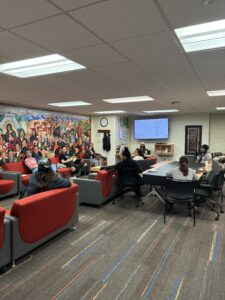
Essence is UW-Madison’s learning community for exploring the Black diaspora, open to all residents, located in Witte and sponsored by the Department of African American Studies. Essence currently houses 57 freshman residents and centers its programming around the department’s academic offerings, community events and peer mentorship. The goal of Essence is to foster belonging, connect students to resources and provide a mental health infrastructure. Here, they learn about the Black diaspora as both programming and oasis.
“Essence built a sense of character and confidence that I feel as if I would have never had in my freshman year,” said Alfred. Alfred lived on Essence before returning as a Housefellow (also known as a Resident Assistant) the following year and later founding the Essence’s peer mentorship program, the Peer Mentor Collective.
As of Fall 2024, Black students made up only 2.82% of all undergraduate student population enrolled at UW. As Dr. Jessica Stovall, faculty director of Essence and assistant professor in the African American Studies Department, puts it: “You could sit in your class all day long and not see anybody that looks like you.”
It is a reality she knows personally. Stovall attended UW–Madison as an undergraduate more than 20 years ago and says plainly that not much has changed. UW–Madison has never surpassed 3% Black student enrollment in its entire history, a distinction that makes its Black student population the lowest in the Big Ten.
Essence is rooted in something simple: visibility. In a state and campus where Black students are a minority of the overall population, seeing peers and mentors who share your identity can reflect the full complexity of what Blackness means. This type of visibility offers a kind of psychological anchoring that no campus counseling appointment can replicate.
“Safety is so much more than fight or flight,” Alfred said. “The safety of seeing someone who looks like you, who may have a different intersectional identity in the diaspora, and being able to correlate just on your identity in a predominantly white institution in an isolating space like Madison. That’s pretty powerful.”
According to a 2025 study published in the Journal of Diversity in Higher Education, structural and interpersonal forces can make Black students feel unwelcomed or marginalized, playing a direct role in academic success as well as on their mental health.The Center of Diease Control and Prevention reported in 2023 that suicide is now the third leading cause of death among Black individuals aged 15 to 24.
Efforts like the Essence community are the answer to these crises. “It bridges that sense of sigh and relief that we as Black students are deserving to feel in our experience,” Alfred added.
For many Black students, mental health support has to begin somewhere other than a clinical setting. Alfred is direct on this point: “The systems of mental health are anti-Black.”
“Mental health is not linear. Our feelings are not linear. Our experiences are not linear,” she added.
What Essence offers is “community as care.” According to a 2004 Research in Higher Education study, Adding Value: Learning Communities and Student Engagement, involvement, academic success and institutional engagement in campus life are significantly higher for students participating in living-learning communities, or LLCs, like Essence.
The residence floor’s culture of cooking together along with music spilling into the hallways and impromptu dinners create a sustained, low-barrier emotional support that surpasses what formal systems can provide.
It is, in Alfred’s words, community and “escapism from the realities of campus.”
Shakur Habane, a freshman majoring in computer science and data science, echoes that feeling. He chose Essence almost by accident, selecting it during the housing application without knowing what it was. By his second month at UW–Madison, Essence’s peer mentors had connected him to the National Society of Black Engineers, Eritrean Student Association, Black Student Union and the Multicultural Student Center, resources he did not know existed that are open to all students.
“Coming back to Essence – after being in classes [that are] predominantly white – was really comforting to have people that look like me,” Habane said. “It’s a vibe — good chemistry, having fun, and getting some studying done.”
Essence is not alone in this model. Universities across the country are adopting similar models creating living learning communities for students interested in learning about Black community and culture. Western Washington University’s Pamoja House has operated as a similar Black-centered living and learning community, offering comparable programming built around cultural affirmation, peer mentorship and academic support. Similarly, Marquette University’s Umoja Community consists of 20 students celebrating black excellence while also creating a space for students to discuss racial justice issues and improve Black student experience on campus.
Still, Alfred is honest about the program’s limitations, and about what it would take to scale its impact. Budget constraints have consistently capped the floor’s programming capacity. A community of 57 students with a $4,000 annual budget leaves little room for the robust events that can deepen a sense of belonging.
Alfred has long advocated for Essence to expand to a full floor, not just for the numbers, but for what a second resident assistant would represent: two voices, two identities, two people equipped to handle the complex interpersonal dynamics that arise in any living community.
“To have two different people of different identities would have been so helpful,”Alfred said. “When handling conflicts, when handling gender norms, authoritative figures, just to have that would have made a huge difference.”
Shereni agreed. “Even if it’s in different dorms, having the community within different dorms would have been very beneficial. You have so many students of color, but it's only like 50 people in Essence. We could have more spaces like that.”
Dr. Stovall echoed those limitations, pointing to structural barriers beyond just funding. At UW–Madison, theme communities in the residence halls come at no extra cost, but living-learning communities typically carry an additional fee on top of the base residential rate. The African American Studies department chose to waive that cost for Essence, an unusual move, but a deliberate one.
“We just really wanted to not have cost be any sort of barrier for somebody choosing to be where their home is,” Dr. Stovall explained. Regardless, the disparity in institutional support remains stark.
“Other learning communities have support from larger financial bodies on campus,” schools such as the business school’s Business Connect learning community. She noted, a reminder that Essence operates within goodwill where others operate with the support of larger financial backing.
While Essence – now five years old – has not expanded in size, it has expanded into a formal learning community, with a curriculum connected to the African American Studies Department. It has proven itself to be a huge step in the right direction for incoming Black students to maintain their mental health here at this predominantly white institution.
But Alfred’s vision is bigger. She sees Essence not as a niche accommodation for Black students, but as a model that is targeting community building as a structural necessity for black students’ mental health.