
By Laine Casey
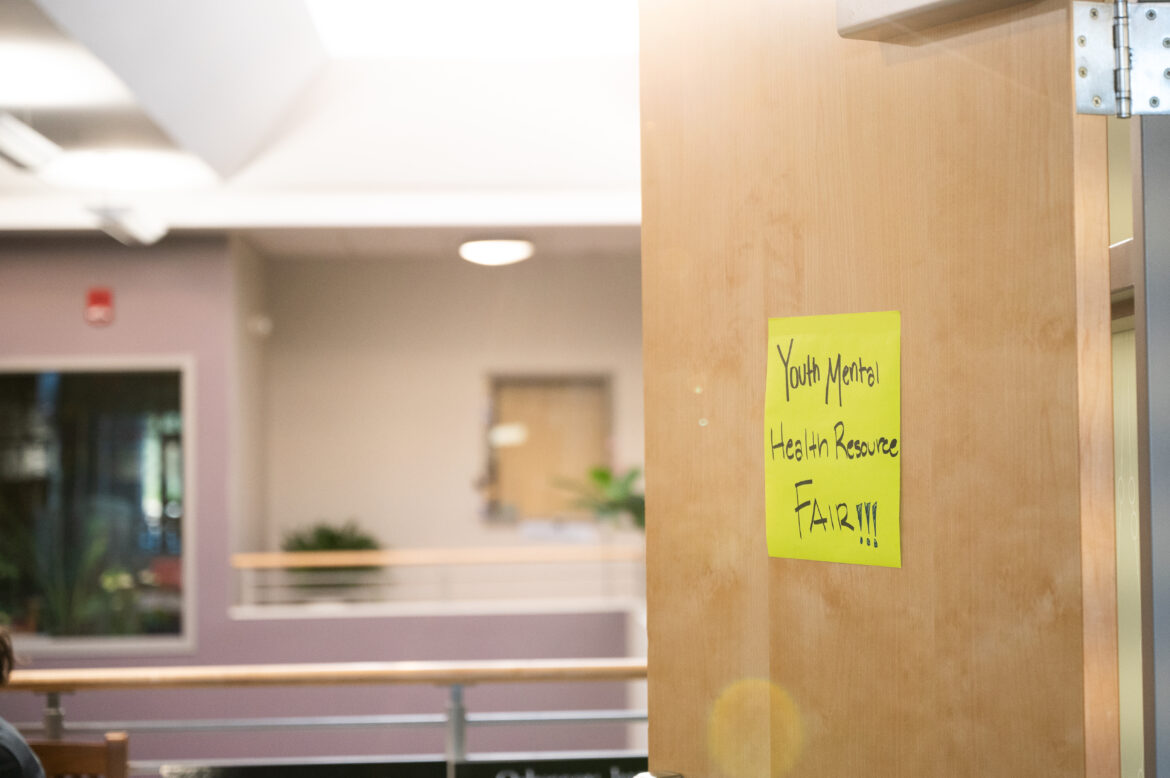
On Thursday, April 16, about 45 people from community organizations, service providers and local advocates gathered at the UW Odyssey Project for a youth mental health event hosted by Madison Commons and its partners.
What was designed to connect parents with youth mental health resources became something more: a candid exchange about the realities families actually face when trying to provide for their basic needs.
While they discussed topics like legal rights and access to health care, a deeper truth emerged.

For many families, things like housing instability, healthcare gaps and the challenges of daily survival all negatively impact youth mental health. That means mental health care providers are increasingly doing much more than counseling and therapy: they’re now working to help families find stable housing, medical care and resources to navigate job searching.
Though that work is not what mental health care providers were originally hired to do, it’s now a regular part of their job. And many consider this kind of “wraparound care” to be more than just a bonus service—for many providers, it’s an essential component of the entire model of care.
“We’re constantly trying to find ways to link people to immediate crisis support that we don’t necessarily have. We’re on the phone calling people, making connections,” one provider at the fair noted. “And, we’re doing this work hoping that they see this is how we get things done, to be kind of proactive in the approach, right?”
Asked a participant: “Are you saying that you are now able to act as a holistic kind of center?”
Around the room, providers nodded their heads emphatically: “Yeah, absolutely,” said one.
First surfacing in the late 1980s, wraparound services became a more popular approach in the 1990s as a way to keep kids out of institutional settings. The term describes an approach in which providers go beyond traditional therapy to support families across a wide range of needs, such as navigating healthcare systems, connecting with housing resources, arranging transportation or even just figuring out which organization to call first.
Rather than treating mental health as an isolated issue that is addressed only in a therapist’s office, speakers at the event described getting involved in the messier, more practical parts of a family’s life.
Throughout the conversation, providers described their work with youth mental health that looks nothing like the textbook version. Support doesn’t always mean a 50-minute session. It can mean sitting with a parent while she updates her insurance information, making sure a teenager can actually get to an appointment or helping a family figure out where their next meal is coming from, according to the providers in conversation at the fair.

Photo: Paige Valley
Johnathan Delgado, a crisis stabilization case manager at Anesis Foundation for Mental Health in Madison, put it plainly: “Mental health sometimes is the symptom of the thing.”
Larger challenges like food insecurity, unstable housing and social isolation are often contributing factors to higher rates of depression and anxiety in young people.
That correlation was evident in the example shared by Beatriz Quintana, a bilingual parent peer support staff member also with Anesis Foundation for Mental Health. She described spending hours with one parent to help her update her medical records and schedule wellness appointments, and the representative showed her how to locate helpful resources.
Those tasks, she explained, can feel completely overwhelming for people – especially those with young children – that are already dealing with stress and trauma.
At some point during time together with one family, the parent said, “This is why I don't do any of this.”
The provider’s response: “Don’t worry, I’m here with you. We’re gonna accomplish it.”
Rather than handing families a list of referrals and sending them on their way, many providers described walking them through the process of getting help. Multiple speakers stressed the importance of not making families retell their most painful experiences to agency after agency, each time starting over from scratch.
Wraparound care, at its best, tries to lessen those burdens and lighten the workload through collaborations within the community-organizing groups in Madison. For young kids, for example, early childhood environments pave the pathway for mental health later on, but many families cannot afford to give their kids enough resources or support, or they are often absent, working multiple jobs in order to buy groceries. These kids often experience housing insecurity as well.
“And so there's a lot of that collaboration that has to happen,” said one provider at the fair.
The need for wraparound care isn’t going away. The World Health Organization estimates that one in seven adolescents globally experiences a mental health disorder, with most cases going unrecognized and untreated. The same organization identifies violence, abusive parenting and severe socioeconomic hardship as recognized risk factors, and warns that limited access to quality services makes mental health conditions worse.
Providers at the event related those statistics to what they personally witness every day: families stretched thin by economic pressure, without stable housing or reliable transportation, turning to community organizations to fill gaps that the healthcare system was never set up to handle.
Speakers were also honest about the limits of wraparound care. Building trust with families takes time. Coordinating across organizations takes adequate staffing. And the demand keeps growing – the Centers for Disease Control and Prevention reported that whereas about 15% of kids in 2016 were experiencing mental health issues, that number jumped to one in every five kids by 2023.
None of that is easy to absorb. Some research has even shown that if providers cannot do a good job of wraparound support, then they should not do it at all, and instead spend more time on intensive case management, according to a 2015 Adm Policy Mental Health study.
However, most times, there is not a lot of choice for the provider; the choice always has to be to help wherever and whenever possible.
“We’re trying to put out those fires,” said one provider at the event. “In order for the child to commit to thriving in a health program…the whole band has to thrive.”