
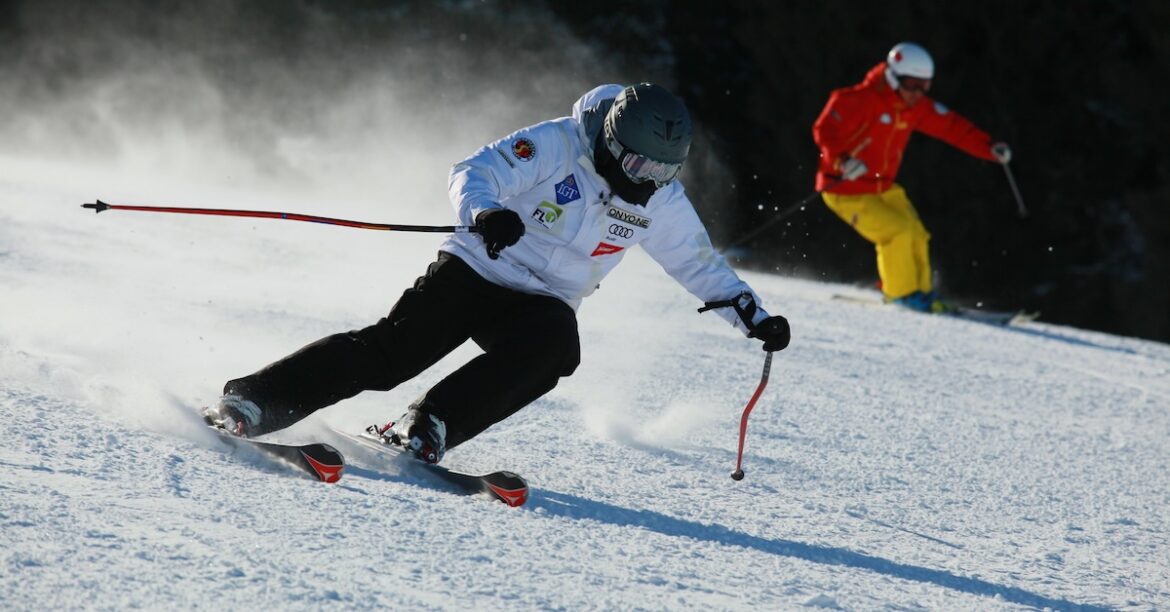
When Steve Eliasen was in his 20s, he and his friends packed into a car every Saturday and drove to the Greenbush ski trails of eastern Wisconsin.
There, the nordic skiers would do a couple loops on the fresh white snow. From December to late February, trails like these, and at ski resorts across the state, were covered in powder, ready to welcome skiers from all over the country.
Today, however, the skiing enthusiast says he’d be lucky to get a handful of days with enough snow to Nordic ski on the trails of Greenbush.
“Will winter be here? Is winter real or not anymore?” said Eliasen, a Wisconsin native.
Over the years, Wisconsin has established itself as a winter wonderland, offering ski resorts, ice fishing, snowmobile trails and more. Faithful locals and curious tourists find their peace in the slopes and hills of Wisconsin. But as climate change intensifies, that identity is shifting. Warmer winters and less predictable snowfall are forcing both residents and tourists to adapt. For ski resorts, this means taking matters into their own hands and coming up with solutions to overcome Mother Nature.
History of Wisconsin’s Winter Tourism Industry
Around the mid-19th century, Wisconsin began attracting new visitors. What was once the land of lead mines was now reframing itself as a state to explore. But this shift didn’t happen overnight, and word didn’t spread on its own.
Businesses and organizations turned to marketing and publicity efforts to draw in citizens from around the country. Photographs were published, railways connecting Chicago and Milwaukee were finalized, and postcards were sent back home from starry-eyed travelers.
When Rib Mountain opened in winter 1927, the ski area now known as Granite Peak, was not only the first in Wisconsin, but one of the first in the country. The skiing craze had officially begun, and Wisconsin was its forerunner.
Winter Tourism in Wisconsin Today
Today, there are more than 30 ski areas operating in Wisconsin — the third most in any U.S. state. Beyond downhill skiing, the tourism industry is a vital component of Wisconsin’s economic structure. In 2024, Wisconsin welcomed 114.4 million visitors, who contributed $25.8 billion in economic impact. This tourist-generated impact has reached unprecedented levels in Wisconsin for the third consecutive year. These record-breaking numbers keep Wisconsin running, they set the stage for more businesses, more activities, more attractions — and, today, more risks to crash.
The Climate Working Group of the Wisconsin Initiative on Climate Change Impacts reported that 2024 was the warmest year in Wisconsin since the 1890s, when statewide temperatures were first recorded. This change in Wisconsin’s climate makes winters shorter and warmer, affecting a broad range of industries and sectors of the economy.
Natalie Chin, a climate and tourism outreach specialist for Sea Grant, a statewide research, education and outreach institute, said changes in climate are not going in one direction, but rather creating an all-around effect that makes predicting weather more difficult.
“We’re seeing more extremes, and sort of ping ponging between extremes,” Chin said. “We expect to have snow in the winter, and, you know, that’s changing now.”
According to the National Weather Service, regions in northern Wisconsin usually see 40-70 inches of snow during a season. But during the winter season of 2023-24, these same regions only saw “5 to 25% of their normal snowfall.” With less snowfall, more rain and weather becoming increasingly unpredictable, ski resorts across the state are turning toward innovations in artificial snow making.
“I think in the ’80s and ’90s, snowmaking was looked at more as like a supplementary system,” said Benjamin Bartz, the chief of mountain operations and development for Midwest Family Ski Resorts, a family-owned operator of three major ski resorts in the Upper Midwest. “Basically in my lifetime, it sort of moved in the direction of becoming essential.”
Bartz said that for ski resorts like Granite Peak, the process of water collection and artificial snowmaking is an integral part of its business plan, adding that it makes skiing conditions more predictable.
“We actually look at the consistency of man-made snow as a benefit to ski area operations because it creates a layer of snow that's really dense and consolidated so that we can offer skiing reliably regardless of whether it rains or if it's really sunny for a long period of time,” Bartz said.
One of the largest concerns surrounding artificial snowmaking is the water used to meet ski resorts’ needs. Bartz explained snowmaking is more a water storage technique than it is consumptive. In fact, he says the skiing industry estimates that 20% of the water used to make artificial snow is lost to either sublimation or evaporation. The other 80% melts and is stored in the mountains the same way natural snow is.
“That’s the primary environmental concern that we hear about,” Bartz said. “But it’s also one that we’re focused on.”
Aside from environmental concerns, some are concerned about the conditions created by artificial snow. But many skiers, like Lily Hansford who grew up skiing near her hometown of Green Bay, don’t even notice the difference.
“I think that artificial snow is a good thing,” Hansford said. “From a ski standpoint, it’s good to know that it works when it needs to.”
Marketing Efforts and a Shift of Mind
Eliasen, an avid skier himself, took his passion for outdoor recreation and created a career for himself. For five years, Eliasen worked in the marketing department of what is now known as Snowriver Mountain Resort in the Upper Peninsula of Michigan.
Here, he was tasked with a tall order: Get skiers to the slopes when they don’t see snow outside.
“When you look out your window and it’s brown, it’s brown and 52 [degrees],” Eliasen said. “It’s really hard to sell skiing and to say, ‘Trust us, we have great snow up here, and it’s cold enough.’”
And instead of relying solely on the winter season and the success of ticket sales, Eliasen had a different idea. Since 2022, Snowriver Mountain has transformed itself into a year-long destination,offering hiking trails, waterfall sightseeing, horseback riding and more. This transition allowed the ski resort to earn revenue all year long, rather than relying on a four-month period.
“And the question was: Why isn’t every ski resort doing this?” Eliasen said. “They’re perfect [areas] for ATVS, Jeeps and motorcycles, and a whole lot of other stuff.”
In addition to adding summer experiences, ski resorts have also shifted their marketing messages and customer perceptions.
Bartz said the narrative surrounding ski resorts and the ski season needs a facelift. Instead of expecting the slopes to open their doors on Thanksgiving Day, Bartz said ski resorts are starting to spread the message of later seasons.
“If you ski in February with 10 inches of new snow, that is one part of skiing, but we need to more fully develop what spring skiing looks like,” Bartz said. “It is still fun and still a great thing to do with friends and family. It just doesn't look the same. And we need to change that perception to not be a negative one.”
Ashley Zachor, a Wisconsin skier since she was 7 years old, uses the slopes to connect with both nature and her family.
“I enjoy going to ski hills and resorts to be surrounded by nature and fall in love with the winter season,” Zachor said. “My dad is who introduced me to skiing, so I find it to be a great way to connect and spend time with him.”